




Cambridge Checkpoint is an international assessment designed to provide schools, parents, teachers and students with valuable information about students’ learning and progress within the Cambridge Curriculum Framework.
The Checkpoint assessments offer a summary of students’ academic performance at the end of key stages (Stage 6 - Primary and Stage 9 - Secondary). They help identify students’ strengths and areas for improvement across subjects and skills, and allow schools and families to compare performance with Cambridge international benchmarks.
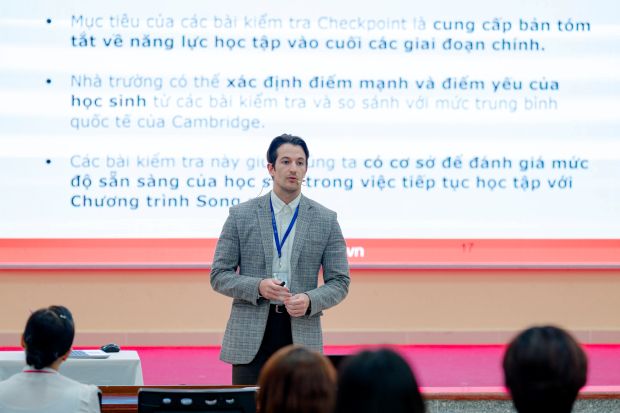
Through Cambridge Checkpoint, Royal School gains an additional reference point for evaluating students’ readiness to continue their learning within the bilingual programme pathway.
Overview of Cambridge Checkpoint
- Royal School administers Cambridge Checkpoint in the following subjects: English as a Second Language (ESL), Mathematics and Science, accompanied by guidance workshops for parents and students.
- The assessments are administered and marked by Cambridge Assessment.
- Students are encouraged to sit all three subjects.
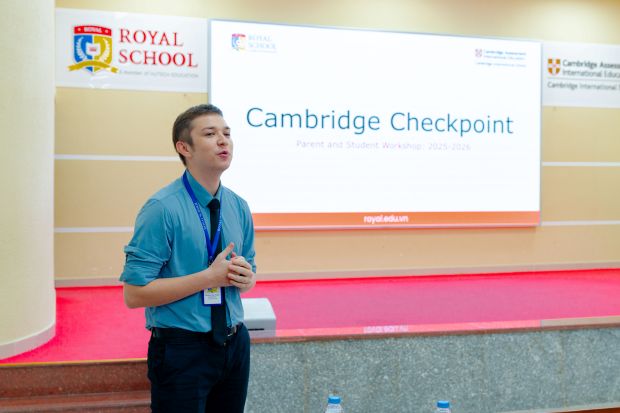
Royal School also organises workshops on Cambridge Checkpoint for parents and students at its campuses.
Assessment structure
Primary Cambridge Checkpoint - Stage 6
| Subject | Paper | Duration | Maximum mark | Total |
|
English as a Second Language (ESL) 1. Reading and Usage 2. Listening 3. Writing |
1 2 3 |
35 minutes 25 minutes 35 minutes |
34 20 35 |
89 |
| Mathematics |
1 2 |
45 minutes 45 minutes |
40 40 |
80 |
| Science |
1 2 |
35 minutes 35 minutes |
40 40 |
80 |
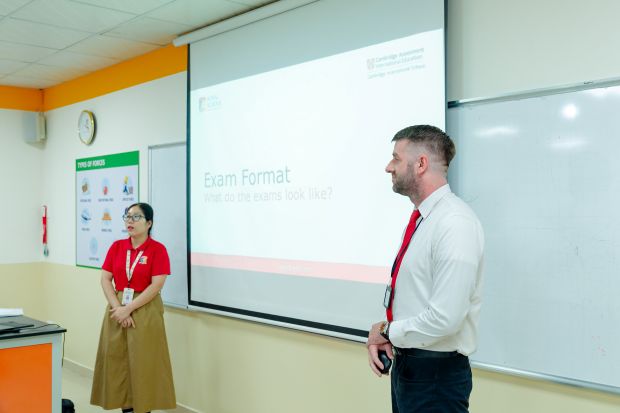
Royal School teachers introduce students to the structure of the Cambridge Checkpoint assessments.
Secondary Cambridge Checkpoint - Stage 9
| Subject | Paper | Duration | Maximum mark | Total |
|
English as a Second Language (ESL) 1. Reading and Usage 2. Listening 3. Writing |
1 2 3 |
45 minutes 35 minutes 40 minutes |
42 25 35 |
89 |
| Mathematics |
1 2 |
60 minutes 60 minutes |
50 50 |
100 |
| Science |
1 2 |
45 minutes 45 minutes |
50 50 |
100 |
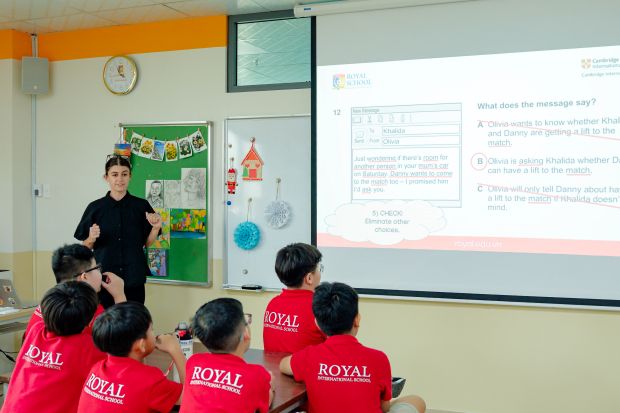
Students become familiar with the assessment format and question types through sample papers and guided practice.
Marking system and scale
All Cambridge Checkpoint results are reported on a scale of 1 to 50, converted from raw scores and adjusted annually using statistical analysis to reflect variations in difficulty.
The questions and levels of difficulty vary each year. Some questions carry higher marks because of their complexity, so students are advised to manage their time carefully in order to maximise their scores.
Achievement bands
| Level | Minimum Checkpoint score | Minimum raw score |
| Basic | 1 | 21 |
| Aspiring21 | 11 | 39 |
| Good | 21 | 56 |
| High | 31 | 70 |
| Outstanding | 41 | 79 |
Descriptions of achievement levels
- Basic: Students demonstrate a basic level of knowledge and skills, with limitations across several areas of the curriculum.
- Aspiring: Students show characteristics between the Basic and Good levels.
- Good: Students demonstrate secure understanding and skills in most areas, with some aspects still requiring development.
- High: Students show characteristics between the Good and Outstanding levels.
- Outstanding: Students demonstrate comprehensive understanding and are well prepared for the next stage of learning.

Cambridge Checkpoint results are reported on a 50-point scale in accordance with Cambridge’s standardised scoring system.
Official Cambridge Checkpoint assessment schedule
Primary
- ESL: 13 May 2026
- Mathematics: 11 May 2026
- Science: 20 May 2026
Secondary
- ESL: 12 May 2026
- Mathematics: 19 May 2026
- Science: 21 May 2026

The Cambridge Checkpoint assessments will be administered in May 2026 in accordance with Cambridge’s official examination schedule.
Support and registration for Cambridge Checkpoint
Royal School provides structured support to help students become familiar with the format and question types of the Cambridge Checkpoint assessments. This includes individual practice on the Exam Go platform, in-class preparation using sample papers, and revision classes scheduled to begin in March 2026 in accordance with the School’s plan.
Parents may register their children to sit one, two or all three subjects. Registration is completed through the Student Affairs and Services Management Centre. Registration forms will be distributed to parents at the beginning of January.
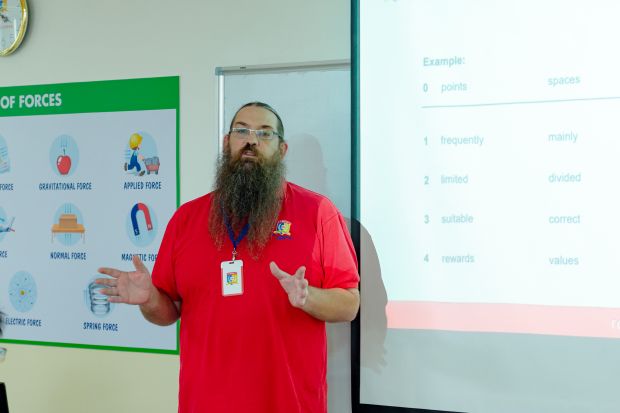
Royal School plans to organise revision classes beginning in March 2026.
Frequently asked questions
1. Is Cambridge Checkpoint compulsory, and must students take all three subjects?
- No. Parents may choose for their child to sit one, two or all three subjects according to individual learning needs and pathways.
2. Is Cambridge Checkpoint a certificate examination?
- No. Cambridge Checkpoint is an assessment designed to provide reference information. It does not award a formal certificate.
3. How are Cambridge Checkpoint results used?
- The results provide information about students’ academic performance and progress, supporting the School and parents in monitoring and guiding students’ learning.
4. Are the results used for promotion to the next grade?
- No. The results are not used as a condition for promotion to the next grade.


Parents asked questions during the Cambridge Checkpoint workshop.
Through the Cambridge Checkpoint assessments, the School gains a stronger basis for identifying students’ strengths, areas for improvement and readiness for the next stages of learning within Royal School’s international bilingual pathway.
By Ngoc Khoe
Photo: Media Team
Admissions and Marketing Centre
ROYAL SCHOOL
 royal@royal.edu.vn
 Royalschool.vn
 Royalschool
 royal.edu.vn
 royal.edu.vn
-
Phu My Hung Campus
8 Dang Dai Do, Tan Hung Ward, HCMC
Phone: (028) 7 100 7878 -
Phu Lam Campus
2 2D Street, An Lac Ward, HCMC
Phone: (028) 7 101 6669 -
Celadon Campus
Celadon City, 1 D2 Street, Tan Son Nhi Ward
HCMC
Phone: (028) 7102 0287